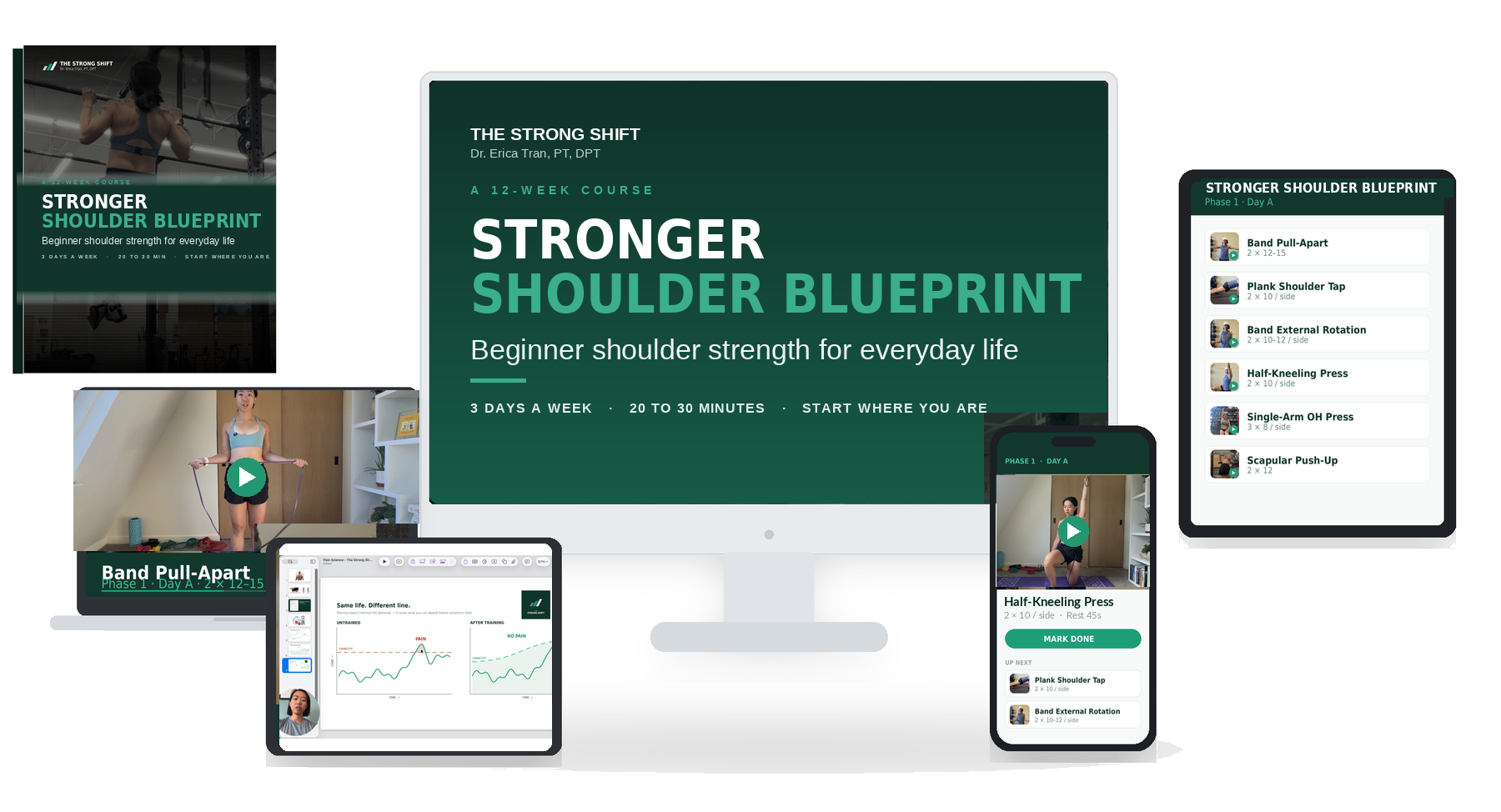
12 weeks of shoulder strength practice · $97 one time
Newer to strength training and second-guessing your shoulders? Stronger Shoulder Blueprint helps you learn where to start, what to practice, and how to progress gradually. A self-paced video course and three planned sessions a week, made for ladies, gays and theys who are newer to all of this.
The Problem
Maybe you pause before reaching onto a high shelf. Wonder whether you should carry that grocery bag. Or look at your suitcase and think, can I lift that?
You want to build strength. But a collection of exercise videos doesn't tell you which option fits you, how much resistance to use, or when to do a little more.
And when your shoulder clicks, it adds another layer of uncertainty. Sound alone doesn't establish a diagnosis. But you deserve clear guidance about what's worth getting assessed and what a sensible next step looks like.
You don't need to become a gym person to begin. You need an appropriate starting point, instructions you understand, and a plan connected to your life.

Who's teaching this
My shoulder dislocated three times. I have had two rotator cuff tears. Not from anything dramatic. Brushing my teeth. Reaching for a mug on a high shelf. Pulling on a jacket.
What I remember most isn't the pain. It's the hesitation, that half-second pause before reaching for something while you run the odds. I started quietly rearranging my days around a joint I didn't trust.
Strength training is what changed that for me. Not rest, not avoiding things, not being careful. Learning how to load the joint on purpose, in the right order, starting smaller than I wanted to. That's my story, not a prediction of what anyone else will experience.
Today I have zero shoulder pain. Full overhead range, and I hang from a bar for fun. That's my experience, not a promise of yours.
I'm a physical therapist working in orthopedics with a board certification in orthopedics, the OCS. I also coach a weekly women's strength class, teaching squats, deadlifts, and overhead presses. My favorite part is explaining why we're doing an exercise and connecting it to something that matters outside the workout.
And I think about my aunt. She worked hard for years in the restaurant business and never really got started with exercise. Not because she couldn't, but because nothing ever looked like it was meant for her. I want people like her to have a welcoming way in, instead of feeling they have to already be athletic before they begin.
This course brings together simple explanations, practical demonstrations, and encouraging instruction. It isn't CrossFit, and it isn't individualized physical therapy. It's a focused introduction to everyday shoulder strength.
The Transformation
Over twelve weeks you'll learn how to choose, practice, and gradually progress beginner shoulder exercises, with everyday reaching, carrying, and lifting as your reason for showing up.
You pick an activity that matters to you, then use it to give your practice direction. Reaching a shelf. Carrying groceries. Getting ready for the demands of travel.
The goal is stronger, more capable shoulders and more confidence in your own training decisions. It is not a promise of pain relief, a cure, or a particular lifting result.
Why This Approach Works
Education and exercise belong together. Knowing what an exercise is for, and how to adjust it, gives you far more to work with than copying a movement off a screen.
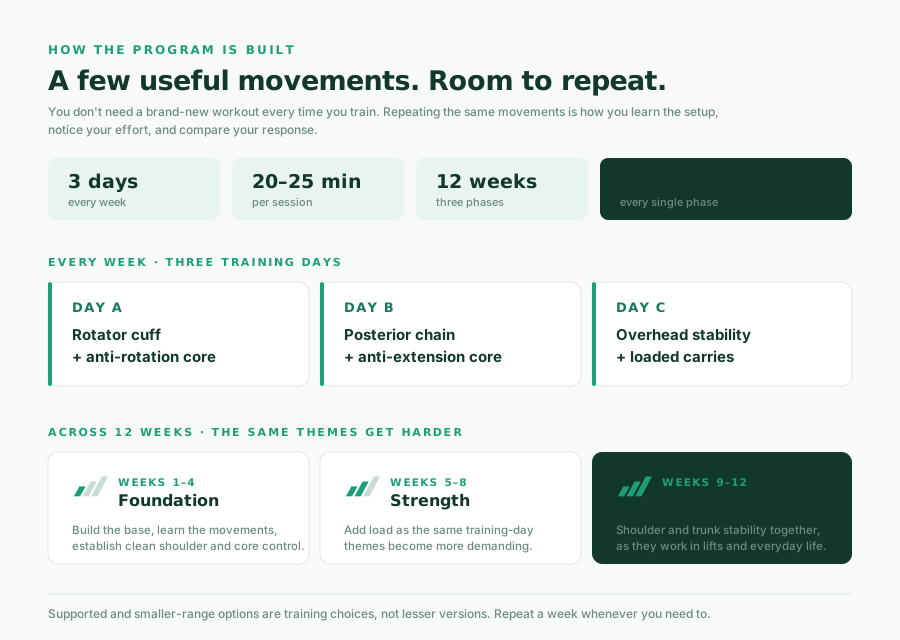
Three nonconsecutive sessions a week, roughly 20 to 30 minutes each, across three four-week blocks: Find Your Starting Point, Build Your Base, and Practice Everyday Strength.
Every exercise includes a starting option, an easier option, and a progression, with written sets, repetitions, rest, and effort guidance.
The calendar gives you structure, not a deadline to outgrow your starting point. You can repeat a week instead of advancing automatically.
What's Inside
Five education modules plus a twelve-week beginner shoulder strength plan. Videos are captioned, and written instructions let you review the details in whichever format suits you. You get twelve months of access, so you can revisit lessons and repeat weeks without treating the schedule as a race.
Make sense of common shoulder concerns and choose an everyday goal that makes practice meaningful.
Take the guesswork out of setting up and choosing a manageable first option.
Learn the foundational movements you'll return to all the way through, with easier and harder options.
Follow a clear three-day rhythm and learn how to progress without racing the calendar.
Connect your practice to daily tasks and leave with a repeatable plan for continuing.
Who It's For
Built for ladies, gays and theys who are newer to strength training. That covers two people. Someone who has never picked up a dumbbell and wants a calm, credible way to begin. And someone who has been lifting for a while but has never trained their shoulders on purpose, and quietly isn't sure they are doing it right. No age bracket, no athletic background required. If you already write and progress your own shoulder programming with confidence, this will be too gentle a starting point.
It's intended for people whose shoulder concerns are stable and appropriate for self-directed exercise, with individual assessment first when that's needed.
Honest Answers
That's exactly who this is built for. You'll learn setup, starting resistance, and exercise options. You're not expected to know them already.
Depends what you mean by lift. If you squat and deadlift but have never programmed shoulder work on purpose, and you are not sure whether what you are doing is helping, this fills that gap. If you already write and progress your own shoulder work with confidence, this will be too gentle. I would rather tell you that now.
No. The plan uses light dumbbells, a resistance band with a secure anchor, and a sturdy chair or counter. Setting up your equipment is part of the teaching.
Three sessions a week, roughly 20 to 30 minutes each. You can repeat weeks, and you have twelve months of access to revisit everything.
The course explains what clicking and pain can and cannot tell you, and when to adjust or get help. It cannot determine what's causing your symptoms or whether this routine suits your specific condition. Clicking with pain, instability, weakness, or a recent injury deserves assessment. Severe pain after an injury, visible deformity, or sudden loss of function calls for urgent medical care.
No. The course is self-paced. It includes demonstrations and general adjustment guidance, not personal form reviews, live coaching, or individual clinical care.
No. I'm an orthopedic physical therapist with an OCS, but this course is general exercise education, not diagnosis, physical therapy, or individualized treatment. Pain relief and clinical outcomes are not promised.
That may need individual guidance first. Recent injury or surgery, recurrent dislocations, significant unexplained weakness, numbness, or worsening symptoms should be assessed by a clinician before you start. This course cannot provide medical clearance.
You'll use effort, movement quality, and how you respond, not just the week number. Every exercise has a starting option, an easier option, and a progression, and the decision sheet helps you choose.
Twelve months, so there's room to replay lessons and repeat weeks.
The aim is to know how to choose and practice beginner shoulder exercises, make gradual progression decisions, and continue with a repeatable routine tied to a goal that matters to you. Progress varies, and the course does not guarantee pain relief or a specific lifting ability.
You don't have to commit to becoming a different kind of person. Start with an everyday goal that matters to you, and learn how to practice toward it.
Self-paced 12-week course · five modules · captioned demos and written instructions · calendar, tracker, and worksheets · 12 months of access
Buyer Confidence
This course gives you structured education and a gradual practice plan for building everyday shoulder strength. It does not promise pain relief, a cure, or a particular result in twelve weeks.
This is a non-physical item. See the Refund Policy for current terms.
This course is educational exercise content, not physical therapy or medical treatment. Buying it does not make you Dr. Tran's patient. Exercise carries a risk of injury. Check with a healthcare professional before starting, especially if you have a current injury or a condition that affects your training. Full disclaimer.